In-depth
Lace
Merletto, pizzo, trina are synonyms for lace which indicates artefacts obtained out of nowhere, without any textile support, by combining stitch upon stitch with needle and thread or interweaving a certain number of threads spooling off special reels, named bobbins. Other techniques use crochet hooks, knitting-needles, the tatting shuttle or, in macramé, simple knotting of threads by hand.
Main technique typologies: needle and bobbins. The point in the air is made starting from a design, bordered by tacking (warping), raised above a wooden cylinder (murello) placed on a padded cylindrical cushion (cuscinello). The construction of the decorative motif (called guipure) proceeds alternating a great variety of points and creating the background (barrettes or sbari in the Venice point or rete netting in the Burano point), finally adding embossing and filling. In the bobbin technique, once the design is affixed onto the tatting cushion (placed on an overturned scagno stool, in a basket or on the knees), one proceeds to braid a certain even number of threads spooling off wooden bobbins (fuselli or mazzette) and fixing the progressive steps by means of pins. Work may be with unbroken threads or in separate parts.
Materials. In the past, threads of superfine linen, but also of silk, gold and silver, were employed, while since the 20th century, cotton in particular. The main characteristic of needlepoint lace is its consistency and in bobbin lace its lightness.
Manufacturing stages
1.THREADS USED NOWADAYS
COTTON
- n° 0 “orso” cordonnet
- n° 4 “orso” cordonnet
- n° 40 mercerised thread
- n° 50 mercerised thread
- n° 80 mercerised thread
- n° 100 mercerised thread
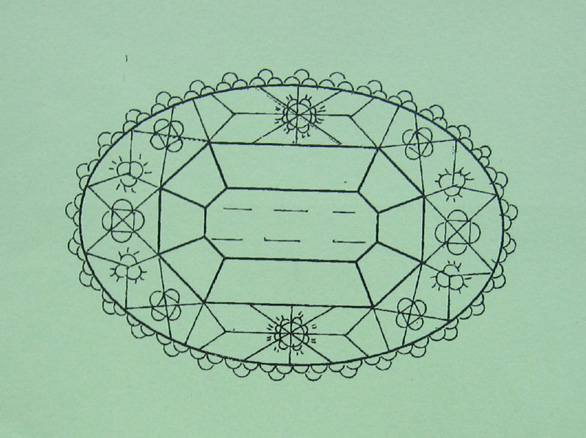
2. DESIGN
Project for a brooch
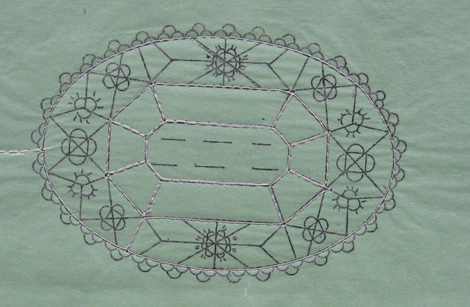
3. WARPING
it is made of two layers of fabric, three sheets of straw-paper, a sheet with the design and a sheet of greaseproof paper; all stacked.
Seams are executed with a pedal sewing-machine following all the design profiles within which the guipure and external support for the Venice point lace will be carried out.
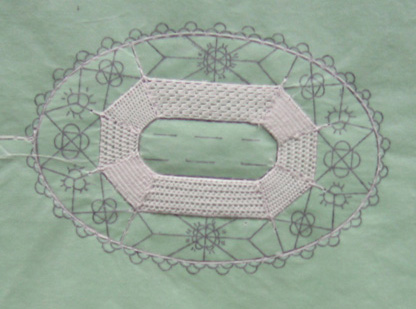
4. GUIPURE
it identifies the first stage of actual work which includes several sub-points, which are the following in this specific case:
- triple Greek with a Greek line
- Greek netting
- fixed Sacolà
- light Sacolà
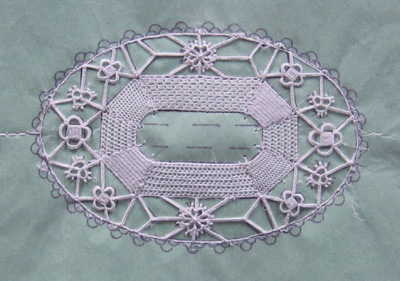
5.VENICE POINT
made by a series of small bars connecting the various shapes and is composed of many sub-points, which are the following in this specific case:
- simple Bars
- three-fold Rosettes with picot
- eight-fold Rosettes with picot
- four-fold Vovetto (small egg) with a Rosette and no picot
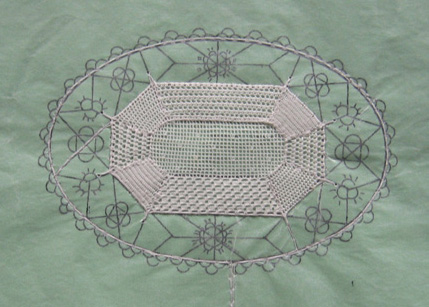
6. BURANO POINT
it is made by a net of tiny rectangular meshes and can present various inner decorations, the following in this specific case:
Rede macà or bruised Net
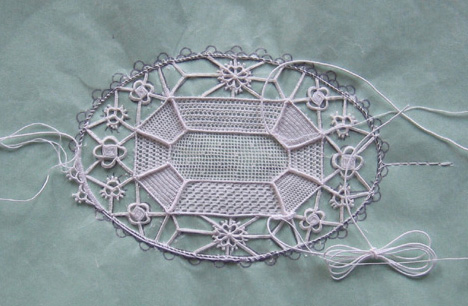
7. FLAT RAISED-WORK
made by applying a thin thread (80) onto a cordonnet thread (0) by small points following the profiles of the design, whose shapes have been filled in by the guipure.
RAISED GROS-POINT may be obtained in two ways:
- adding a cordonnet thread (0) to the flat raised-work by buttonhole stitch (called scallop by the embroiderer)
- applying a metal thread along the outer border paired with a cordonnet thread, linked together by the buttonhole stitch, over which a three stitch scallop is executed.
8. FINAL STEP
Having completed the border with the buttonhole stitch and three stitch scallops, the artefact is turned upside-down and one proceeds to detach it from the various layers of fabric and paper cutting the warping with a cutter and finally eliminating the fragments of remaining threads by means of tweezers.
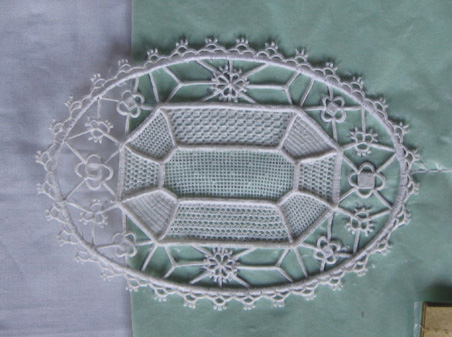
9. FINISHED BROOCH
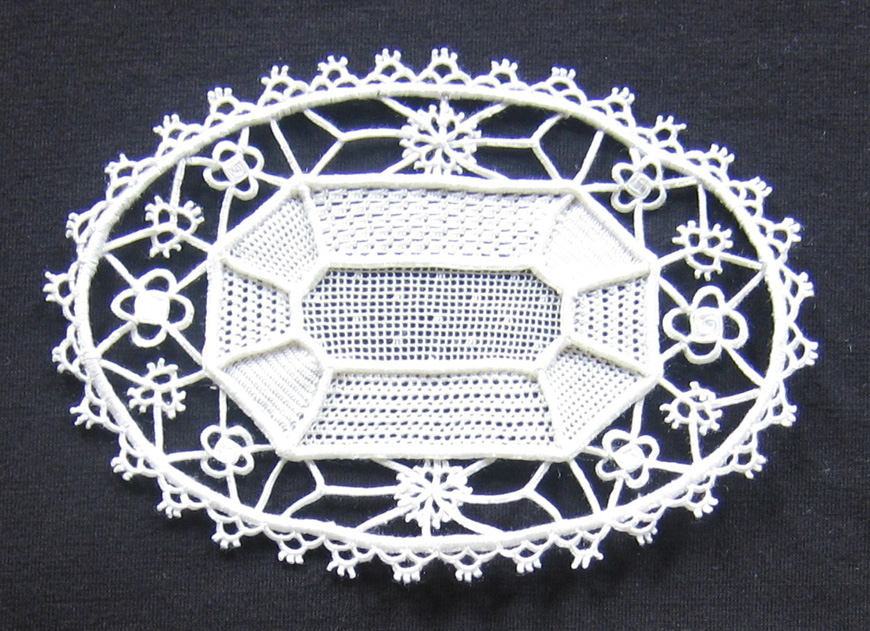
10. ANOTHER BROOCH SAMPLE
The following points are present here:
- Creme by 13; creme by 7, light sacolà; fixed sacolà; double Greek (=guipure)
- Venice point: row of bars with picot
- Burano point: net with creme on 7 rows.
- Raised-work: flat; twisted; Gros point.
Glossary
Lace Tools and Terminology
Barbole: bands of lace placed as ornamentation to caps. Used since the 1600s, in the 1800s they decorated hats.
Blonde: silk bobbin lace, with a netting background. Originally from France, from the mid-1700s, it then spread to Venice and Spain. The term derives from French “blonde”, from the colour of the natural silk used; dyed in black it was preferred for making bauta capes (Venetian Carnival disguise).
Burato: fabric with a very loose warp, used as a support for embroidery, which was to get a book dedicated to it in the 1500s.
Rabat collar: male “downturned” collar, formed by a quadrangular panel (afterwards two rectangular ones) of lace that just covered the shoulders, then falling down in the front. Used from 1600, in 1700 it changed into a jabot and is still used nowadays by gowned magistrates.
Bertha collar: round collar (also called “godet”) positioned as a cape to enhance the necklines typical of the second half of the 1800s; a mediaeval revival recalling the name of Charlemagne’s mother.
Berlin collar: designation given by the Burano Lace School to a model probably commissioned from Berlin.
Pistagna collar: designation given by the Burano Lace School to a shawl-collar model with elongated ends.
Cushion (small): see tombolo cushion.
Facciole collar bands: strips of fabric or lace placed around the neck from the end of the 1600s; used by abbots also in the 1700s.
Filet: square mesh netting embroidered in linen stitch and darning stitch with a shuttle or needle, called “modano” or double headed needle.
Fichu: triangular shoulder-kerchief with ends thrust into the bodice (corset) or crossed in front and tied behind. Worn by dames and bourgeoises in the last quarter of the 18th century, it varied in the quality of its fabric it was made of.
Grotesque: this term designates a type of wall decoration deriving from that discovered in Nero’s Domus Aurea (in the so-called “grottoes”), composed of a light and fanciful array of vegetable forms intermingled with human figures, extravagant animals and narrative scenes. Appearing at the beginning of the 1500s, it underwent a naturalistic revival during the 1700s.
Mitten gloves: bare-finger gloves, up to the elbow, made of embroidery or lace; fashionable in France in the age of the Sun King; at the end of the 19th century they were only used in the evening only.
Needle-lace: lace made with a needle and linen thread (in cotton as well since the 20th century) without employing any support, using a cussinello cushion, similar to a bobbin pillow, upon which a wooden cylinder rested (murello) covered by a cloth on which the design was previously drawn.
Bobbin lace: once the design was fixed onto the pillow one proceeded by braiding threads connected to the bobbins (also called piombini or mazzette) and fixing the work with pins.
Macramé: (from the Arabic mahrama) still made today in the area of Liguria, it is created from thin air by knotting threads fixed high up, then left freely hanging, into a fringe downwards.
“Meander” motif: decoration which developed starting from 1740, characterised by parallel series of waving vertical tendrils from which more or less natural floral posies branch off.
Pilgrim: (from Fr. pélerine, wide collar on the pilgrim’s mantle), in the 1600s reaching towards the waist at the back and with long ends in the front; in the 1700s and 1800s, shaped like a semi wheel.
Burano point: type of needle-lace differing from the Venice point in its background, made of a netting with tiny rectangular meshes similar to the vertical sequence of ladder rungs.
Coral or flat point: flat needle-lace, with decorative flimsy and contorted branching taking inspiration from coral growths, which developed from the last quarter of the 1600s.
Milan point: bobbin lace characterised initially by continuous motifs, with no background, created separately in linen stitch and then assembled in the final stage. In the 1600s a background with simple or double bars appeared at first, then a round or hexagonal mesh netting, also found in Flemish artefacts.
Pellestrina point: bobbin lace appearing at the beginning of the 1600s, very similar in its technique (linen stitch, braid, tent stitch) and decoration to its contemporary Milano point, from which it differs in the background bars, often “Y” shaped.
Rose point: needle-lace with decoration distinguished by the miniaturisation of its elements and the superimposition of multiple layers, developed from 1680.
Venice point: type of needle-lace differing from the Burano point in its background, formerly chaotic and now honeycombed, made by interlacing simple barrettes (sbari) or with picots (pippiolini) produced by buttonhole or scallop (cappa) stitch.
Flat Venice point: see coral or flat point.
Venetian Gros point: characterised by a free interpretation of decorations in leaf or floral shapes rendered with a great amount of padding and fillings. It developed from 1650 at first simply with joined motifs, then with a barrette background. Famed in Europe as Gros point de Venise .
Venice point cut into leaf-work: similar to the previous, but characterised by the lack of padding and fillings.
Renaissance embroidery: similar in appearance to lace, it is based on the positioning of a thin toile strip made with bobbins in linen stitch, or woven on a loom, according to a predefined design, connected by filling elements in needlework. This is an economical version of the Venice point cut into leaf-work.
Netting: an ancestor of lace. A type of embroidery obtained by drawing out warp and weft from a fabric base so as to reduce it to few vertical and horizontal threads on which to create a determinate decoration little by little.
Rocaille: decoration inspired by the shell motif (used to embellish grottoes and gardens since the 1600s), from which the Rococo term comes, to indicate an artistic style.
Tombolo cushion: a cylindrical pillow stuffed with straw or sawdust resting on a sort of overturned stool called “scagno”, and used to make bobbin lace. In Venice it is called “balòn” or balloon.
Tramezzo: or insert (from Fr. entredeux), a strip of lace to place between two pieces of fabric.